

Managing Fall Armyworm
in Maize
[Early to Mid-Season Guide: Before Tasseling]
Your first spray against Fall Armyworm can determine the success of your entire season.
But even the best insecticide may fail if you spray at the wrong time or in the wrong way.
This guide will show you exactly how to scout, when to spray, and how to apply correctly to protect your yield.
But even the best insecticide may fail if you spray at the wrong time or in the wrong way.
This guide will show you exactly how to scout, when to spray, and how to apply correctly to protect your yield.
Know Your Enemy
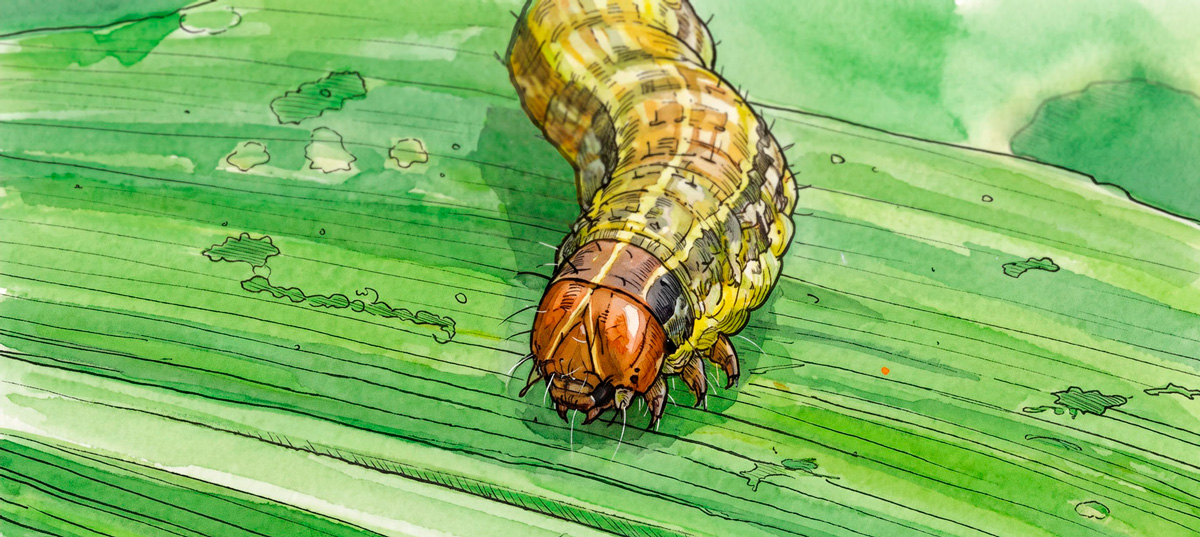
Fall Armyworm (FAW) can attack many crops, but it is most damaging in maize. It goes through six larval stages. As the larvae get bigger, they hide deeper in the plant’s funnel (whorl) — and become harder to control
Stages 1–2
Small larvae, feeding openly on leaves.
✔️ Easiest to control
Stage 3
Moving into the whorl
⚠️ Critical time to spray
(before they go deeper)
Stages 4–6
Deep inside the whorl
❌Hard to control
Spray early. Your best window is Stages 1–3 (small larvae)
Don’t wait for severe damage — by then larvae are big and harder to control
Check Your Plants Regularly
Early and regular checks help you find small larvae when spraying works best.
Start as soon as your maize emerges and check every 7–10 days.
Start as soon as your maize emerges and check every 7–10 days.
How to check your maize field for FAW
Step 1 — Start away from the edge
Walk 5–10 rows in from the field edge before you start checking.
Edge plants can be misleading
Step 2 — Choose a walking pattern
Walk 5–10 rows in from the field edge before you start checking.
Edge plants can be misleading
Step 2 — Choose a walking pattern
- Small maize (up to knee-high): W pattern
- Tall maize: use a ladder pattern (check left–middle–right as you move forward)

The Innovators:
How a Group of Geniuses, and Geeks Created the Digital Revolution
Step 3 — At each stop, check 10 plants
- Stop at 5 points along your route and check 10 plants at each point (50 plants total)

The Innovators:
How a Group of Geniuses, and Geeks Created the Digital Revolution
What to look for
Fresh leaf damage
Small holes, ragged edges, or transparent "windowpane" patches.
Live larvae (caterpillars)
Check the whorl (funnel), not only the leaves — larvae may be hidden inside.
Fresh frass in the whorl
Fresh frass (small droppings that look like sawdust).
Egg masses (usually on the underside of leaves)
Grayish, fuzzy clusters.
How to count infested plants
An Infested Plant must have BOTH:
fresh leaf damage AND a live larva or fresh frass
fresh leaf damage AND a live larva or fresh frass

When to spray
Older plants can tolerate more leaf damage, so the threshold is higher later in the season
Spray if 4 or more out of 10 plants are infested.
(That is 20 or more out of 50 plants inspected.)
(That is 20 or more out of 50 plants inspected.)
Older maize (up to tasseling)

(That is 10 or more out of 50 plants inspected.)
Spray if 2 or more out of 10 plants are infested.
Young maize (up to knee height)

How to Spray Correctly
Spray into the whorl (funnel)
That’s where the caterpillars hide.
Don’t only spray the top leaves.
FAW hides inside the funnel — that is where the spray needs to go.
FAW hides inside the funnel — that is where the spray needs to go.
Spray early morning or late afternoon
Larvae hide from heat and feed when it’s cooler.
Avoid hot midday spraying.
Spray when the sun is low — that’s when your spray works best.
Spray when the sun is low — that’s when your spray works best.
Use enough water to cover the plant
Good coverage = better control.
Use 200–250 L/ha (about 80–100 L/acre).
That’s roughly 13–16 full 16‑L knapsack tanks per hectare (about 5–6 tanks per acre)
Walk steadily so leaves are wetted, not just splashed.
That’s roughly 13–16 full 16‑L knapsack tanks per hectare (about 5–6 tanks per acre)
Walk steadily so leaves are wetted, not just splashed.
Keep pressure steady
A fine, even mist coats the leaves and reaches the whorl.
The spray must come out as a strong, even mist.
If you’re using a knapsack sprayer, pump often to keep the pressure steady and the spray even.
Avoid big droplets (they will roll off the leaves)
Avoid a weak drizzle — it won’t reach into the whorl (funnel).
If you’re using a knapsack sprayer, pump often to keep the pressure steady and the spray even.
Avoid big droplets (they will roll off the leaves)
Avoid a weak drizzle — it won’t reach into the whorl (funnel).
Choosing the Right Insecticide
FAW moths lay eggs over many days, so infestations often come in waves. While some larvae are feeding, new eggs may still be hatching.
To protect your crop, you need an insecticide that helps break this cycle.
Barai® delivers powerful triple action:
By targeting the pest at multiple stages, Barai® helps break the FAW lifecycle and protect your yield.
Barai® is available at authorised
agro-dealers across Zimbabwe.
To protect your crop, you need an insecticide that helps break this cycle.
Barai® delivers powerful triple action:
- Controls young larvae currently feeding on your maize
- Helps prevent eggs from hatching, reducing the next wave of pests
- Disrupts larval development, slowing population build‑up
By targeting the pest at multiple stages, Barai® helps break the FAW lifecycle and protect your yield.
Barai® is available at authorised
agro-dealers across Zimbabwe.

About this guide
This material is provided in good faith as an educational resource for farmers. It is based on authors current agronomic knowledge and best field practices. To make the information practical and easy to understand for readers of all experience levels, certain information have been intentionally simplified.
It is not intended to cover every situation or replace full agronomy manuals, which may provide more detailed, multi‑page procedures.
The goal of this page is to provide a quick, actionable tool for the field.
All illustrations on this page were created or generated using artificial intelligence (AI) to explain key ideas in broad terms. They may not reflect full agronomic detail or exact field appearance.
Always read and follow the official product label instructions before applying any crop protection chemicals.
This material is provided in good faith as an educational resource for farmers. It is based on authors current agronomic knowledge and best field practices. To make the information practical and easy to understand for readers of all experience levels, certain information have been intentionally simplified.
It is not intended to cover every situation or replace full agronomy manuals, which may provide more detailed, multi‑page procedures.
The goal of this page is to provide a quick, actionable tool for the field.
All illustrations on this page were created or generated using artificial intelligence (AI) to explain key ideas in broad terms. They may not reflect full agronomic detail or exact field appearance.
Always read and follow the official product label instructions before applying any crop protection chemicals.